


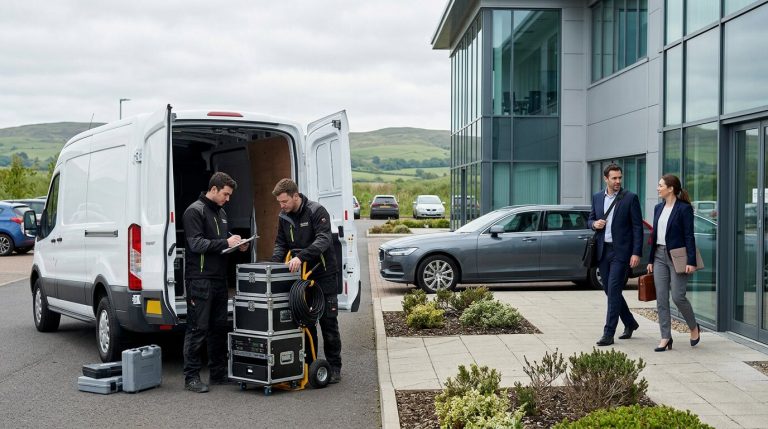
When a business trip has two parts, one carrying kit and one carrying only people, it’s tempting to book one vehicle big enough for both. That’s usually the expensive and awkward option. A van makes a poor taxi, and a car can’t take a pallet of demo stock.
The better approach is to plan each stage on its own terms, then check whether the stages can share anything. This guide walks through one hypothetical two-stop visit in central Scotland, with a worksheet you can reuse for your own trips. It’s written with small businesses and freelancers in mind, where the same few people often handle the install, the sales meeting and the travel bookings themselves.
The scenario (hypothetical)
A small company that installs meeting-room audio equipment has two days in Scotland:
- Day one, Lanarkshire: two engineers install a demonstration system at a client’s premises near Motherwell. They need to move speakers, a rack, cabling and tools.
- Day two, Fife: a sales manager and one engineer meet a prospective client in Leven. They carry a laptop and a small sample case. Nothing bulky.
Same trip, two very different transport jobs. None of this describes a real customer.
Start with what each stage is for
Before thinking about vehicles, write one line per stage: the purpose, the people, the load and the fixed times. For the scenario:
- Stage 1 exists to deliver and fit equipment. The load drives every decision.
- Stage 2 exists to put two people in a room on time. Comfort and punctuality matter. Cargo space doesn’t.
Once that’s on paper, the idea of driving a Luton to a sales meeting in Fife looks as odd as it is.
Stage 1: the equipment-heavy day
For the install, list the kit by size and weight: the rack’s dimensions, the heaviest flight case, the longest cable drum. That decides whether a medium panel van will do or whether a tail lift is needed. The two engineers ride in the cab seats. Nobody travels in the load area, and the kit needs straps or racking so it can’t shift.
Check the route as well as the vehicle. Scotland has Low Emission Zones in the city centres of Aberdeen, Dundee, Edinburgh and Glasgow. They operate around the clock, with camera enforcement. If the drive from wherever you collect the van passes through one, check that the specific vehicle meets the standard, or plan around the zone.
In the scenario, the firm might look for van hire information for Motherwell. That site lists vehicles from small vans and an automatic Transporter up to a Luton with a tail lift, and mentions local delivery and collection. The questions to ask are about the specific vehicle: its internal load length, whether it has load-securing points, the deposit and insurance excess, and whether it can be returned at the end of day one so the firm isn’t paying for a van it no longer needs.
Stage 2: the passenger-only day
With the kit installed, day two is a people problem. There are three realistic options: a car, the train, or both.
Leven has had a railway station again since the Levenmouth line reopened, with services restored for the first time in more than 50 years, according to Transport Scotland. Depending on where the team stays overnight, rail may be simpler than driving. Check the current timetable against the meeting time first.
If a car makes more sense, for example because the client’s premises are some distance from the station or the team has a later call elsewhere in Fife, the scenario firm could look at car availability in Leven. That page covers car hire in Leven and says vehicles are delivered from a Glenrothes depot. Ask about delivery to a hotel or office, the return arrangements, and what documents each named driver needs.
These are two separate enquiries for two separate jobs. Nothing here suggests the hires can be combined into a single booking. Confirm each one directly.
Who drives, and on what licence
Name the drivers for each stage before booking, and check their licences. A standard car licence covers vans up to 3,500kg maximum authorised mass for petrol and diesel, per GOV.UK. Most panel vans and many Lutons sit at or under that limit, but check the plated weight of the vehicle actually offered. Driving a long day of installs and then a long drive afterwards is a fatigue risk as well as a scheduling one, so it can help to swap drivers between stages.
The stage decision worksheet
| Question | Equipment-heavy stage | Passenger-only stage |
|---|---|---|
| Purpose of the stage | ||
| People travelling (all in proper seats) | ||
| Heaviest item / longest item / total weight | Usually none | |
| Vehicle type needed (or train?) | ||
| Named driver and licence checked | ||
| Low Emission Zone on the route? Vehicle compliant? | ||
| Site access: parking, loading point, security sign-in | ||
| Collection time and place | ||
| Return time and place |
Check site security and access ahead
Commercial sites often need visitor names and vehicle registrations in advance, and may only allow vans into a goods yard at set times. Ask the client for both, and send the hire van’s registration as soon as you have it. If the equipment has to stay overnight before the install, ask where it can be stored securely. A van parked outside a hotel with a rack of audio kit inside is an avoidable risk.
Schedule the returns as carefully as the outbound
The neatest version of this trip ends the van hire on day one, once the kit is installed, and starts the passenger arrangement on day two. Write both return times into the itinerary next to the meetings. If the install overruns, you’ll know straight away which return is at risk and who needs a call. That’s the difference between a two-stop trip that runs to plan and one that ends with a spare van parked in Fife.